About Me
Yiming Shen is a Ph.D. Candidate in Applied & Computational Mathematics at the University of Massachusetts Boston, conducting research under Prof. David Degras-Valabregue.
Specializing in Statistical Modeling and Healthcare Data Science, my work bridges the gap between rigorous mathematical derivation and actionable clinical insights. I focus on developing high-dimensional data analysis methods for Brain-Computer Interfaces (BCI) and Medical Imaging.
I am actively seeking Data Scientist roles in the Pharmaceutical and Biotechnology industries.
Technical Expertise
- Statistical Learning & Modeling
- High-dimensional Tensor Analysis, Bayesian Inference, Mixed-Effects Models, Survival Analysis.
- Machine Learning & BCI
- Deep Learning for EEG/MRI, Domain Adaptation, Riemannian Geometry, Feature Engineering (CSP, Log-variance).
- Computational Tools
- R (Expert, Package Development), Python (scikit-learn, PyTorch), SQL, LaTeX, Git.
Selected Achievements
Kaggle Silver Medal (2024) | HMS - Harmful Brain Activity Classification
- Developed a robust pipeline to detect seizures in complex EEG data, achieving a Top 5% ranking globally.
- View Project Detail
R Package Developer | DA4BCI
- Authored Data Augmentation for BCI, an R package optimizing classification accuracy for motor imagery tasks using geometric data generation.
- View Repository
R Package Developer | BCIFeatR
- Built an EEG feature-engineering toolkit in R for creating stable, model-ready representations across BCI sessions.
- View Repository
Open-Source EEG Toolkit (R)
- Maintainer of four EEG/BCI-focused packages:
DA4BCI,TensorEEG,eegwhiten, andBCIFeatR. - Browse Package Projects
Research Framework
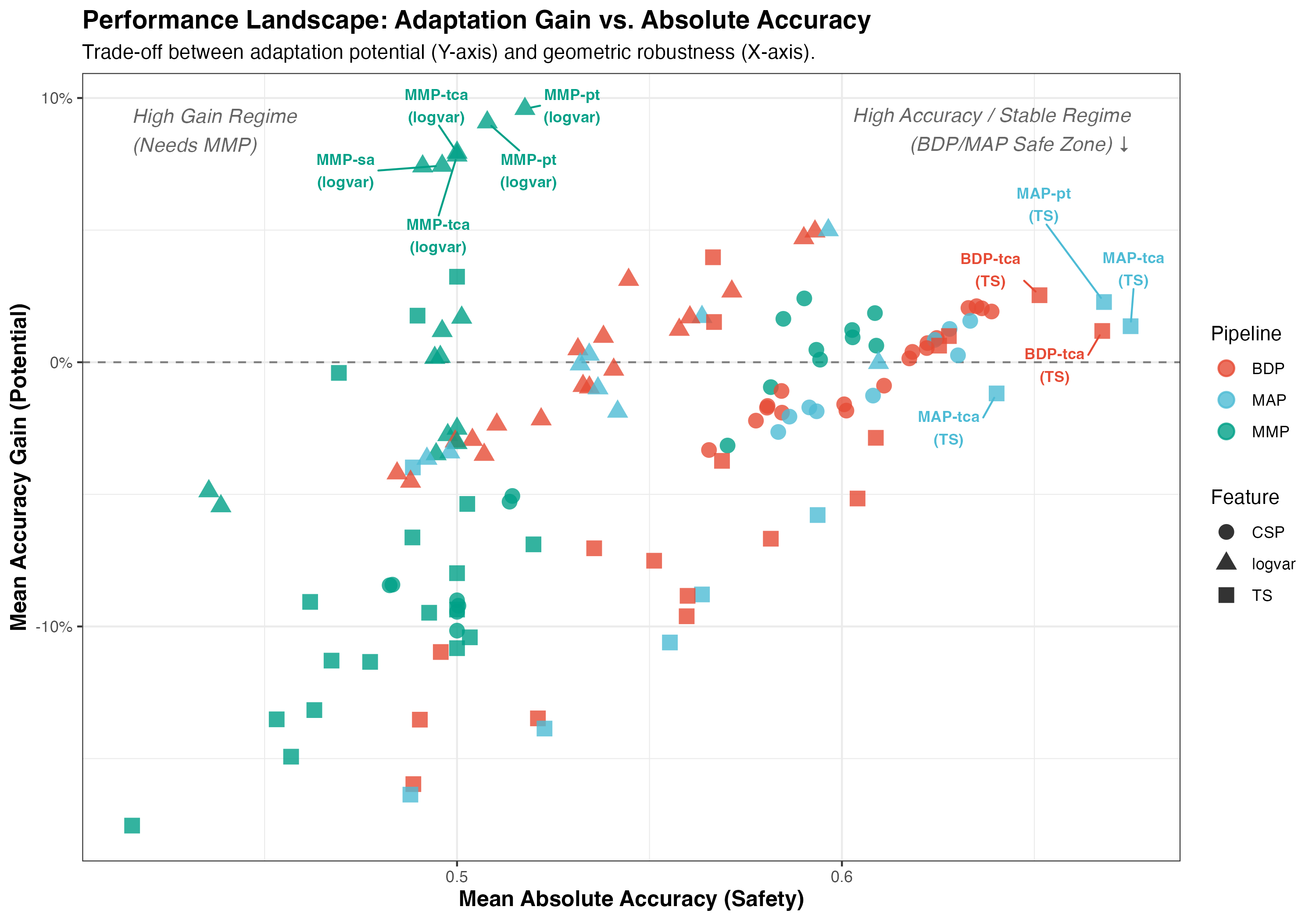
My research integrates High-Dimensional Tensor Analysis with Riemannian Manifold Geometry to solve the fundamental challenge of neurophysiological non-stationarity in Brain-Computer Interfaces (BCI). This framework is structured around three theoretical pillars:
- High-Dimensional Tensor MCCA
- Developed computational methods for Tensor Multiple Canonical Correlation Analysis (TMCCA) capable of handling datasets of arbitrary and mixed orders. This work establishes a statistical framework for integrating multi-view neuroimaging data.
- Geometric Decomposition of Neural Drift
- Analyzed EEG covariance evolution on the Riemannian manifold of Symmetric Positive Definite (SPD) matrices. By projecting representations onto a common unit-trace SPD manifold, I isolate geometric structural distortions from signal magnitude changes to diagnose performance decay.
- Confidence-Gated Adaptive Decoding
- Reframed BCI adaptation as a statistically grounded decision problem. Using Confidence-Interval (CI) Gating and Non-Inferiority Testing, this framework selects optimal adaptation pipelines (e.g., Bridge-Domain vs. Minimum-Distance) based on measured neurophysiological divergence.