Python Package: TensorEEG-py
Milestone:
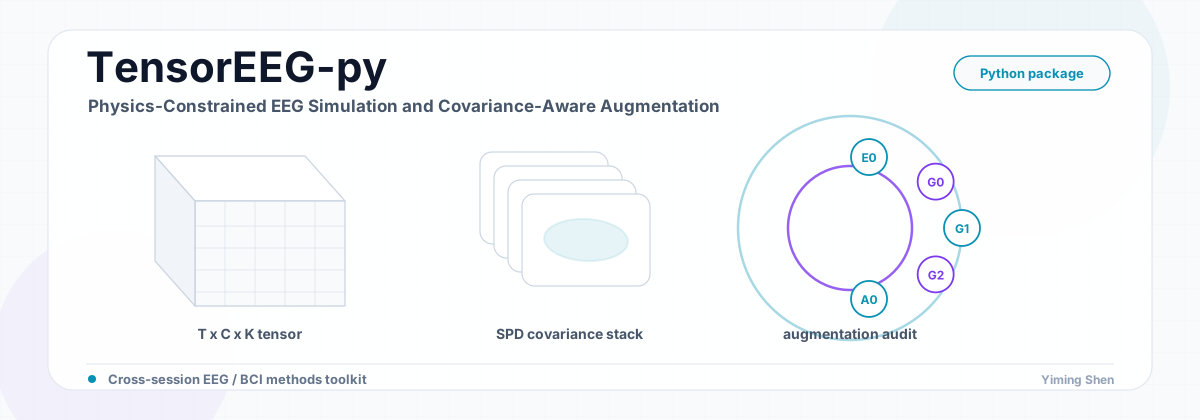
Package: TensorEEG-py
Title: Physics-Constrained EEG Simulation and Covariance-Aware Augmentation
Language: Python
License: MIT
Overview
TensorEEG-py is the Python sibling of the R package TensorEEG. It mirrors the main simulation, covariance augmentation, fidelity audit, and manifest replay APIs so that Python-based EEG pipelines can use the same audit concepts without an R bridge.
Toolkit Role
TensorEEG-py supports Python experiment drivers and reviewer-facing reproducibility checks.
Python protocol manifest -> TensorEEG-py replay -> synthetic covariance stack and fidelity metrics
Main Capabilities
- Physics-constrained EEG simulation with volume-conduction geometry, source dynamics, artifacts, and trial-wise drift.
- SPD utilities for log/exp maps, projection, log-Euclidean distance, affine-invariant distance, and vectorized covariance coordinates.
- Augmentation routines: E0, G0, G1, G2, and A0.
- Six-metric covariance fidelity audit.
- Manifest parsing and replay for experiment-cell reproducibility.
- Bundled demo anchors, labels, and manifest for smoke tests.
Cross-Language Design
The R package is the canonical implementation. The Python package keeps function names and output structures aligned where practical, so that Python and R analyses can exchange manifests and compare fidelity outputs.
Related research
The covariance augmentation audit connects the simulation and augmentation tools to evaluation on real EEG datasets. The study’s real-data audit uses companion Python protocol scripts.