Sparse EEG for Movement and Motor Learning
Ongoing Research
Research question
This direction asks whether a small number of EEG channels can provide useful information beyond motion tracking, surface electromyography (EMG), independent force measurements, cardiac signals, and task history—and whether that contribution remains reliable across training days.
Concept demonstration
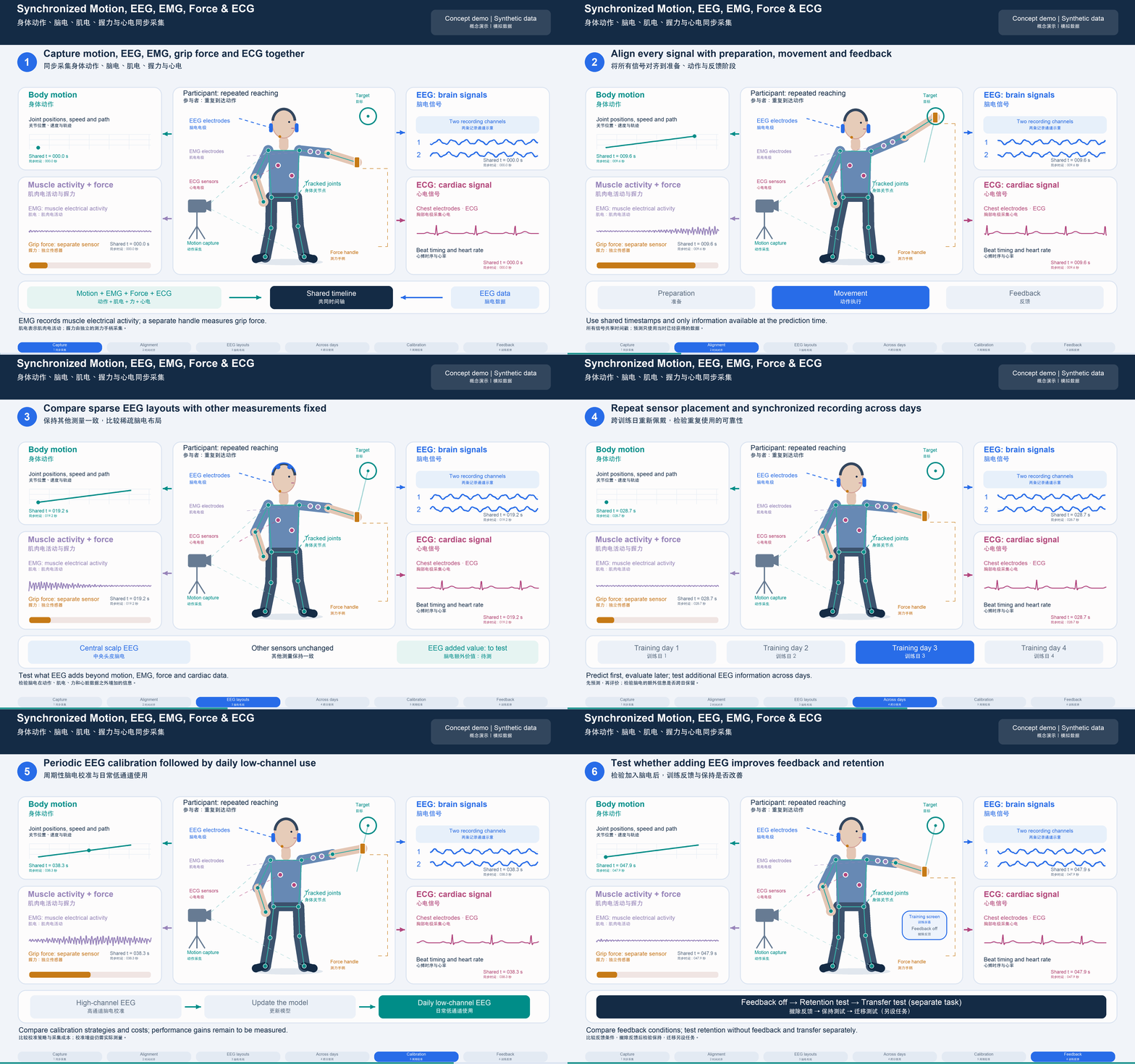
Measuring EEG’s added value
A proposed first study uses controlled upper-limb reaching or target-pointing practice. Synchronized recordings would separate movement preparation, execution, and feedback. The central comparison evaluates the same prediction target with and without EEG, using only information available at the intended decision time. One candidate target is the next movement’s error, predicted from preparation-period measurements.
Motion tracking would measure trajectories, speed, and task error. Surface EMG would record muscle electrical activity, while force sensors would independently measure external force. The demonstration uses ECG to illustrate cardiac measurements. Task-specific artifact measurements and control conditions would help assess the validity of the EEG contribution.
Sparse layouts and repeated use
Planned comparisons include sparse scalp and around-ear configurations under matched channel budgets. Electrode position and reference configuration would be evaluated alongside task performance.
The project also asks whether occasional paired recordings with broader scalp coverage improve subsequent low-channel use. Comparisons would include fixed models, low-channel recalibration, initial high-density calibration, and repeated high-density calibration. Chronological evaluation would measure later-session performance together with recording time, labeling requirements, and setup costs. The demonstration’s two-channel and 64-channel configurations illustrate candidate arrangements; the protocol remains under development.
From prediction to motor-learning feedback
Predictive value and training benefit are separate research questions. After establishing a reliable EEG contribution, a feedback study would compare feedback based on non-EEG measurements, feedback incorporating EEG, and a matched control. Outcomes would include performance during practice, retention after feedback withdrawal, and transfer to a new task.
Research foundation and collaboration
This direction extends Cross-Channel Prediction, Classification, and Individual Retention in Low-Channel EEG Adaptation, connecting its evaluation of cross-channel information and retention with movement-related measurements and behavioral outcomes.
EEGLayoutLab provides a simulation foundation for examining placement constraints and measurement sensitivity. The planned studies would connect those simulations with measured signals and longitudinal evaluation.
Collaboration interests include movement measurement, motor learning, exercise science, wearable sensing, and statistical evaluation.